


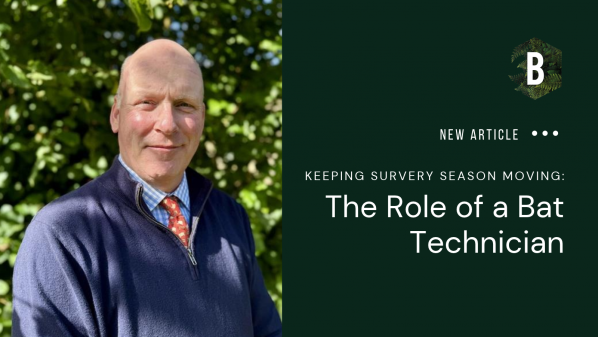
As the 2026 Bat Survey Season has officially come to an end, it is the perfect time to record some thoughts and observations about my role as a Bat Technician at Biodiverse Consulting and what it entails.
Bat Technicians are essentially the operational backbone of the busy bat season, which stretches between April and October every year. In this varied role, I’m required to wear many hats including fieldwork, data analysis, logistical organisation alongside equipment and subcontractor coordination.
Kit Prep & Maintenance
To spin all these plates, preparation is vital!
This applies to working with our ecologists and subcontractors (subbies), but especially to kit preparation and maintenance. Making sure the kit is serviceable and ready to rock and roll requires planning four months before the season commences. The remote monitors (RMs) require a service and need to be sent away for battery checks. Likewise, other essential kit like tablets need clear memory cards and healthy batteries.
As the season starts, so do the early start and late finishes to ensure kit is ready for the day ahead and the next survey, including re-charging batteries and downloading data gathered out on the field. A lot goes into ensuring our kit remains serviceable and can keep up with the demanding pace of a busy bat survey season.
Data Analysis & AI Adoption
Then there is the data analysis. Much of my time and effort is focused on analysis of the data that is gathered using tablets, RMs and cameras. A huge amount of information can come back from a single survey and it’s my job to ensure our ecologists have the information they need when they need it.
Data analysis starts with uploading and securely storing survey data onto our system before carrying out a review of audio, using Kaleidoscope, and analysing video recordings to identify bat species present on a site.
Analysis can be time intensive depending on the number of files that need inspection. Data from a single remote monitor can take between one hour to a full day to upload and analyse. This season, however, we've been able to introduce Bat Scan AI into our video analysis process, hugely improving both accuracy and efficiently in identifying bat movement, reducing analysis time by up to 60%.
Subcontractor Coordination
Subbies, or subcontractors supply essential support to Biodiverse Consulting during the busy bat season. This year we were supported by a keen and loyal cadre of subbies who have produced quality data and have offered valuable flexibility for surveys. As I work very closely with them, they become my extended team during the season and I’ve enjoyed building strong collaborative relationships through the season. One of our bat subbies, Margarida has recently joined our team on a permanent basis which is fantastic to see.
Recruiting and coordinating subcontractors requires early engagement and a brief but comprehensive training program to be delivered so expectations, processes and logistics can be established. I typically cover kit, operations and paperwork. This helps hugely with the smooth running of operations once the survey season is in full swing.
This year, I organised the season into 3 blocks: April-May, July and August and September-October, making subbie commitments easier to manage. Alongside constant and regular communication throughout the season with our subbies, we had a 95% attendance rate. A big thank you to all the subbies for their invaluable support this year.
Team Coordination
Our own team of ecologists are instrumental in the successful delivery of the bat surveys and so extra consideration needs to be given to their seasonal schedules, where they are likely to be project managers and/or survey leads on other projects around the UK.
As a Bat Technician, it’s important to keep an open line of communication the team, ensuring everyone knows the key information like what equipment is being hired, survey updates, RAMS preparation, kit ready for collection and when it needs to be returned for data downloading and recharging. This arrangement has worked well primarily because of in person collaboration which allows for flexibility and, importantly, an understanding of the logistics that goes with each survey.
There are times when a kit needs to be turned around within a couple of hours. Coupling this with the demands of data analysis, it can get frantic. The only way to achieve such tight turnarounds is through master organisation and teamwork.
A Seasonal Reflection
The 2026 bat survey season has gone very well for me, the Biodiverse Consulting team and extended team of subcontractors, and by extension, our clients.
With so many moving parts, choke points and bottlenecks are part and parcel of my role. The mark of a great bat technician is applying problem solving and organisation skills to reach a timely resolution.
With another set of surveys supported and data collected, reflection on the areas that went well and what could be improved for next year is important and it informs my planning for the year ahead. Organisation for equipment servicing and upgrades and training has already started for what will be an exciting 2027, marking our first bat season as part of the Ecology Group. I’m sure it will be bigger and better than ever.